Your Local Comfort Pros of Central Kentucky Since 1970
0% Financing Available With Wells Fargo
Cool Club Membership
Service Areas
Generator & Heat Pump Guide
When the power went out across central Kentucky in January, the homeowners who called us all asked the same thing: how big does a standby generator have to be to keep a heat pump running? It is a heating load question that has to be answered by an electrician, and A-1 Cooling, Inc. does both sides of that job under one roof. Ask for a home power assessment anywhere in Central Kentucky.
Generator & Heat Pump Guide
Between January 24 and 26, 2026, the storm put snow, sleet and 0.20 to 0.80 inches of ice across central and eastern Kentucky, with Greensburg in Green County recording 2.7 inches of snow and 0.25 inches of freezing rain, according to the NWS Louisville storm summary. Power outages peaked around 75,000 customers on Sunday afternoon, January 25, mostly from ice, and 109 counties declared a state of emergency. For a home heated by a heat pump, the question that followed was how big a standby generator has to be to carry it.
A heat pump is really four electrical loads sharing one thermostat, and a generator has to be sized for the moment they overlap. The first is the compressor's starting current. For a fraction of a second when the compressor starts, it draws several times its running current, and that surge, not the running load, is what stalls an undersized generator. The second is the auxiliary electric strip heat in the air handler. The strips run when the outdoor unit cannot keep up on a cold night or when the thermostat is switched to emergency heat, and strip kits are commonly 5, 10, 15 or 20 kW, so a 10 kW kit alone draws more than the compressor does. The third is the defrost cycle. When frost builds on the outdoor coil, the system briefly runs the compressor in cooling mode to melt it while the strips run at the same time to keep the supply air warm, so the two peaks stack. The fourth is the indoor blower, which runs with all of the above.
Typical published figures, with the nameplate on your unit governing in every case: a 2-ton heat pump runs at about 2 to 3 kW, a 3-ton at about 3 to 4.5 kW and a 4-ton at about 4 to 6 kW, and each of them draws a start-up surge several times higher for an instant unless the compressor has a soft-start device. Add the strip heat on top of the running figure, not instead of it, and the picture of why a heat pump home needs more generator than a gas-furnace home comes into focus.
None of this is a reason to avoid a heat pump. It is the reason the generator has to be sized from the actual equipment rather than from the square footage of the house.
Three loads turn an "essential circuits" generator into a marginal one. The first is the well pump. Rural homes in Taylor, Green, Adair, Marion, Washington and LaRue counties are on wells far more often than homes inside the city limits, and a half to one horsepower submersible pump draws roughly 1 to 1.5 kW running and two to three times that to start, and it starts whenever a faucet opens. The second is the electric water heater, which is a standard 4.5 kW element and is the difference between a warm house and a warm shower. The third is the sump pump, which is under 1 kW but starts unannounced, usually while everything else is already running. Any one of them can be the load that lands on top of a compressor start.
Take a 2,000 square foot home outside Campbellsville with a 3-ton heat pump, a 10 kW strip kit, a three-quarter horsepower well pump, an electric water heater, a refrigerator, a chest freezer, lights and a few outlets. The figures below are typical, rounded, and labeled as such; the assessment we do on site replaces them with the nameplate loads on your equipment.
Essential mode. The heat pump runs with the strips locked out, plus the well pump, refrigeration and lights. The running load lands at roughly 8 to 10 kW, with the compressor start on top of that for an instant. That is why the first generator tier exists: a home that accepts a cooler house on the coldest night and lives without strip heat, but wants heat, water and refrigeration, fits there.
Whole-home mode. The heat pump plus the full 10 kW strip kit during defrost or emergency heat, plus the well pump, the water heater and the kitchen. The running load climbs into the low 20s kW before any start-up surge. That is why a heat pump home that wants heat, hot water and a well at the same time, without thinking about which one is running, lands in the second tier.
The larger case. A second HVAC zone with its own air handler and strips, or a geothermal system with its own strip heat, pushes the same arithmetic into the third tier.
We do not repeat the tier lists here; the three generator sizing tiers on our whole home generator page describe each one, what it covers and how the transfer switch is arranged. The one caveat that matters: the numbers above are typical figures, and the home power assessment measures the real nameplate loads, the strip kit actually installed and the pump actually in the well before a generator is chosen.
Two devices change the answer. A soft-start kit on the outdoor unit ramps the compressor up over a fraction of a second instead of slamming it on, which cuts the starting surge enough that a smaller generator can carry the same heat pump. A load-management module on the generator or the transfer switch sheds a chosen load, usually the strip heat or the water heater, for a few seconds while the compressor starts, then restores it once the surge has passed. Both are available on the generator lines we install, and they are the reason two homes with the same heat pump can end up with different generator sizes. Ask us whether a soft-start kit fits your outdoor unit; we size the generator either way.
From Campbellsville to Lebanon, Columbia, Greensburg, Springfield and Hodgenville, A-1 Cooling, Inc. does the heat pump load calculation and the electrical installation as one job, so the generator, the transfer switch and the HVAC equipment are sized to each other by the same people. Call 270-465-3076 to schedule a home power assessment, or read more about whole home generator installation.
Answering Your Questions
Let's Get Started
The best time to size a generator is a calm week in the fall. A-1 Cooling, Inc. measures the real loads in your home, sizes the generator and transfer switch to the heat pump, and installs both across Central Kentucky. Call 270-465-3076 or request your home power assessment online, and we will have a plan in place before the forecast turns.
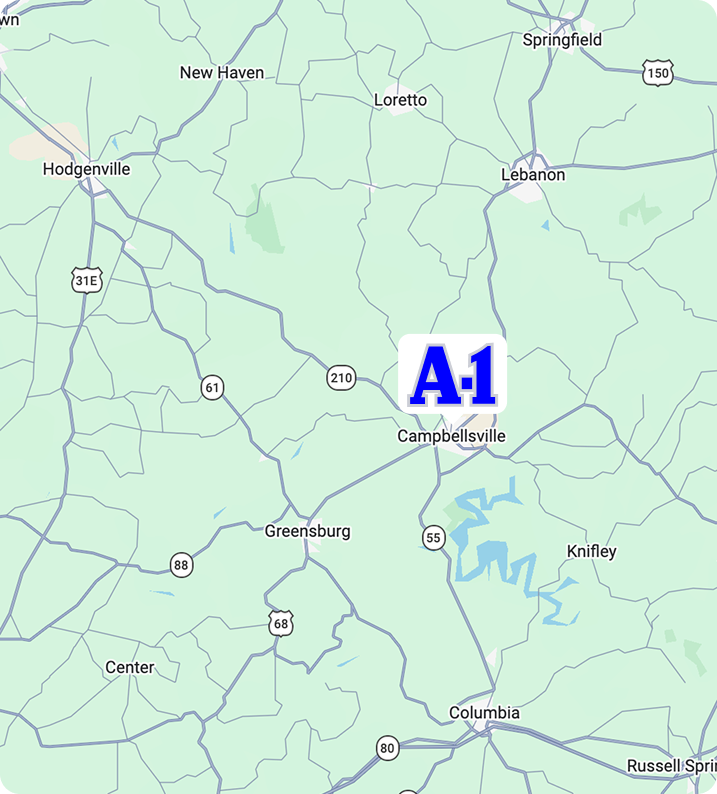
Serving Campbellsville & Central Kentucky since 1970
A-1 Cooling, Inc. is based in Campbellsville, KY and proudly serves families and businesses throughout central Kentucky. No matter which community you call home, our team delivers the same reliable service and expert craftsmanship that we're known for.
We also serve many smaller communities and rural areas throughout Taylor, Adair, Green, Washington, and LaRue counties. If you're not sure whether you're in our service area, just give us a call or visit our contact page. Chances are, we've already been to your neighborhood.

© Red Barn Media Group 2026
